Loading
World Geography
A collection of Anki flashcard decks for geographic recall. Not just names and capitals, but where things actually sit on the map. I wanted to go beyond knowing "Buenos Aires is the capital of Argentina" and be able to point to it. Knowing a city's position relative to its country, its neighbours, and the geography around it should help to make it more memorable in a way that labels alone can't.
Real cards from the decks - 40 cities, 40 countries, 40 NZ cards. Click to flip, Next for another.
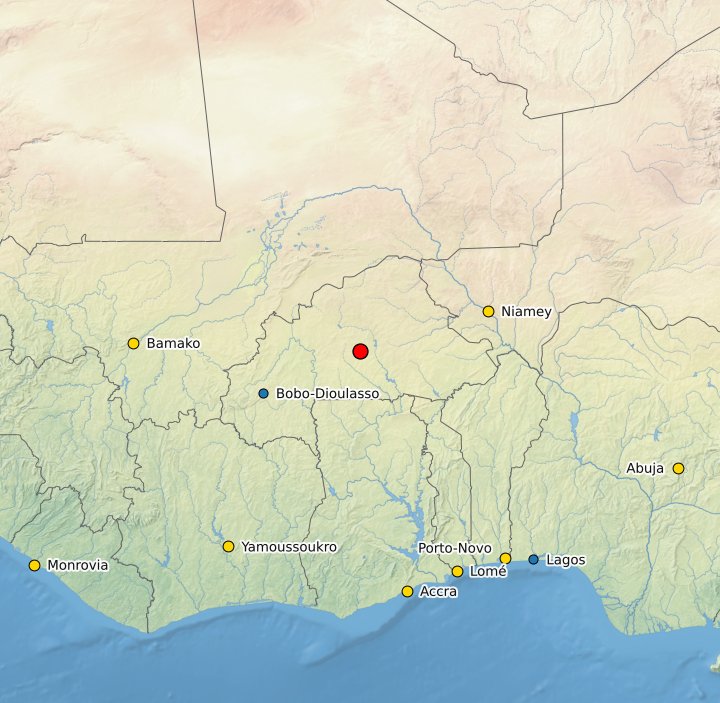
1 of 40
A lot of similar geography Anki decks exist, but most rely on relatively basic vector maps that only show borders, not actual terrain and geography. These decks use raster imagery from Natural Earth as the basemap.
Curation
The first deck I created for this project, the Notable World Cities deck, started with programmatic city selection. Cities were ranked by population, with bonuses for capitals, GaWC classification and UNESCO status. This was promising at first, but ultimately key cities of the world were missed and the end result was skewed towards large countries filled with huge cities.
The final list for every one of these decks is hand-curated. I did my own research to pick places around the world that I think should be included. Some worthy cities are probably still missing, and some inclusions are debatable, but I think the end result is a bit more interesting than the data-driven approach, and I find the process of researching places around the world worth it by itself - I mean, why would I make these geography decks if I didn't like geography?
For some of the decks I found that a bit of extra context was useful to figure out what I was looking at. Context provided its own curation problem - for countries, seeing the map with surrounding borders is enough. For cities, a few nearby cities are shown, picked from the same list of cities in the deck. For features it gets a bit more complicated. With the massive list of features provided by Natural Earth, I built an interactive tool to figure out what makes sense to show on the map next to the target features, and curate the list of inclusions this way. Now I've started working on country deep-dive decks (starting with New Zealand). Their curation requires a mix of several approaches to figure out not only what needs to be included in the deck, but also what context makes sense to show on each card, so there's no ambiguity in what you're looking at and you can learn what is near the place on the card.
How It Works
All decks run through the same three-stage pipeline, using their curated lists:
- Enrich each entry with data from Wikidata, cross-referenced against other data sources like GeoNames (cities) or the LINZ Gazetteer (New Zealand)
- Render a map from Natural Earth raster imagery and boundary shapefiles. A shared renderer handles locator insets, label placements, and fiddling with places near the antimeridian
- Package everything into an exportable Anki deck (.apkg file)
Each deck adapts what a card shows to what makes sense for it: cities mark a dot with contextual badges (capital, UNESCO, global-city ranking); countries highlight the full polygon and flip to population, area, languages and currency; features highlight the polygon with nearby-place labels for context.
Current Status
Notable World Cities Deck645 flashcards ready to study
Capitals, major population centres, and globally significant cities from every country in the world.
World Countries Deck194 flashcards ready to study
All 194 UN-recognised sovereign states. Each card shows the highlighted country polygon on a map; flip to reveal flag, capital, largest city, population, area, languages, and currency.
New Zealand Deck146 flashcards ready to study
A country deep-dive deck covering 8 categories - Cities, Regions, Islands, Peaks, Lakes, National Parks, Rivers, and Landmarks.
The Next Deep Dive?Not started
A new country deck like the New Zealand one. Haven't decided which one yet.
Natural Earth Features DeckShelved
A prototype covering the mountain ranges of the world, still available below. Shelved: country deep-dive decks include natural features now, but the global deck is off my radar.
Downloads
How to import into Anki
Desktop (Anki for Windows / Mac / Linux)
- Download the
.apkgfile - Open Anki, then go to File → Import
- Select the downloaded file - the deck appears in your collection immediately
Alternatively, just double-click the .apkg file and Anki will open and import it automatically.
Mobile (AnkiDroid / AnkiMobile)
- Download the
.apkgfile to your phone - Open the file from your downloads - it will open directly in the Anki app
- Confirm the import when prompted
If the file doesn't open automatically, open Anki and use the import option from the menu (AnkiDroid: the three-dot menu; AnkiMobile: the downward arrow icon).
Get Anki: desktop (free) · AnkiDroid (free, Android) · AnkiMobile (paid, iOS)
Data Sources
This project would not be possible without the amazing work of the volunteers behind Wikidata and Natural Earth.
GeoNamesCC BY 4.0LINZ Data ServiceCC BY 4.0LINZ BasemapsCC BY 4.0GaWCvia Wikipedia, CC BY-SA 4.0Organisation of World Heritage Citiesvia Wikipedia, CC BY-SA 4.0
City coordinates are cross-referenced against GeoNames under a CC BY 4.0 licence.
This project includes data from the LINZ Data Service and aerial imagery from LINZ Basemaps, both licensed for reuse under CC BY 4.0.
Global city tiers are adapted from the GaWC research network roster, and world-heritage badges from the Organisation of World Heritage Cities membership roll. Both were compiled via Wikipedia, whose text (rather than GaWC's or the OWHC's own data) is licensed under CC BY-SA 4.0.